


Dear Reader,
As you know, I am an alien trapped in the mind of a human shitbag. That human is Happy Julius Pipe, and he lives in American Suburbia.
It’s an odd place, the suburbs, and much different from anything I experienced on Xobtihs. For example, on Xobtihs, allocants can go years, even lifetimes, without direct contact with other allocants. And in the event of a chance encounter, it is customary to exchange polite intercourse and hold deep philosophical conversations until the system reallocates your resources.
In American Suburbia, polite intercourse is largely frowned upon, and you can go years, possibly lifetimes, without holding deep philosophical conversations. It’s rather unsettling. And humans with differing opinions can be real assholes.
But before I speak of the assholes, may I present my qualifications as an alien anthropologist. First, while I have no formal training in the discipline, I am a keen observer in my own right. On Xobtihs, I interacted with as many as three or four allocants in my lifetime, the majority of whom told me, “Kuf, you might be the only person I’ve ever met, but surely, you’re the most observant.”
Second, as an interdimensional being, my take crosses the veil of habituation. As the wise shitbag says, “A fish cannot describe the water.” Need I remind the reader that I am not a fish?
When I first laid eyes on American Suburbia, I could hardly believe its beauty. Lit neighborhoods flicker in the distance. Rows of similar homes, full of driveways and tightly mowed lawns, shimmer in the human sun. Dogs roam freely on clenched leashes, and the humans who walk them offer great nods to other dog walkers, who each keep a hand on their leash like a six-shooter.
Every family unit has a black Suburban Utility Vehicle. Its primary purpose is to transport one to three small humans to a field where other small humans kick balls and scream at unprecedented levels until their adult supervisors, called coaches, disintegrate like dandelion seed heads and sob with such desperation that I started reading Henry David Thoreau to better understand the moment.
Yes, American Suburbia has an ample and glorious shine, and Happy Julius Pipe could taste it when he first staked his claim, just before the birth of his second son, R2.
He landed with a fresh hope, like a refugee who has endured the hardship of urban parking. Everywhere he looked, neighbors talked freely about quality tradesmen and youth sports. His neighbor told him that Arnold’s son was enrolled in a nearby Spanish-immersion elementary school. Happy has chatted with this man for ten years now, and still he has no idea who Arnold is, but no matter.
In American Suburbia, anything is possible. But what conveys hope often hides truth, and the truth, it turns out, is in the many verbs these humans have adopted for survival: driving, enduring, shuffling, rescheduling, subsisting and, most of all, withstanding.
The best a human can do in American Suburbia is withstand it. The dangers besiege the stoutest of heart, and Happy is a real fragile fuck.
They found him early in his homeownership. Happy opened the front door to retrieve a package and allowed the soft morning sun to rouse him from a poor night’s sleep. A deep cup of coffee in hand, he wasn’t paying attention when his three-year-old at the time, R1, escaped to the front yard in nothing but his Spider-Man underwear. His small human proceeded to skip rocks in the neighbor’s yard just as the neighbor opened his door to get his newspaper. The neighbor turned to Happy, still too sleep-deprived to notice what was happening, when R1 proceeded to take a healthy whiz on a bordering rhododendron. He wasn’t rude about it. He smiled at the neighbor the entire time. At this point, Happy had spilled his coffee on his crotch and could do nothing but offer profuse apologies for his feral child.
His neighbor smiled brightly, but, holding those dagger eyes, proceeded to tell Happy how nice it was to see a child with so much energy. “Arnold’s son probably spends too much time reading,” he said.
Happy smiled and apologized as he retreated to his house. It was later, as he applied aloe vera to his nethers, that he developed the mantra to defend himself against his neighbor’s judgments: “Fuck Arnold’s son.”
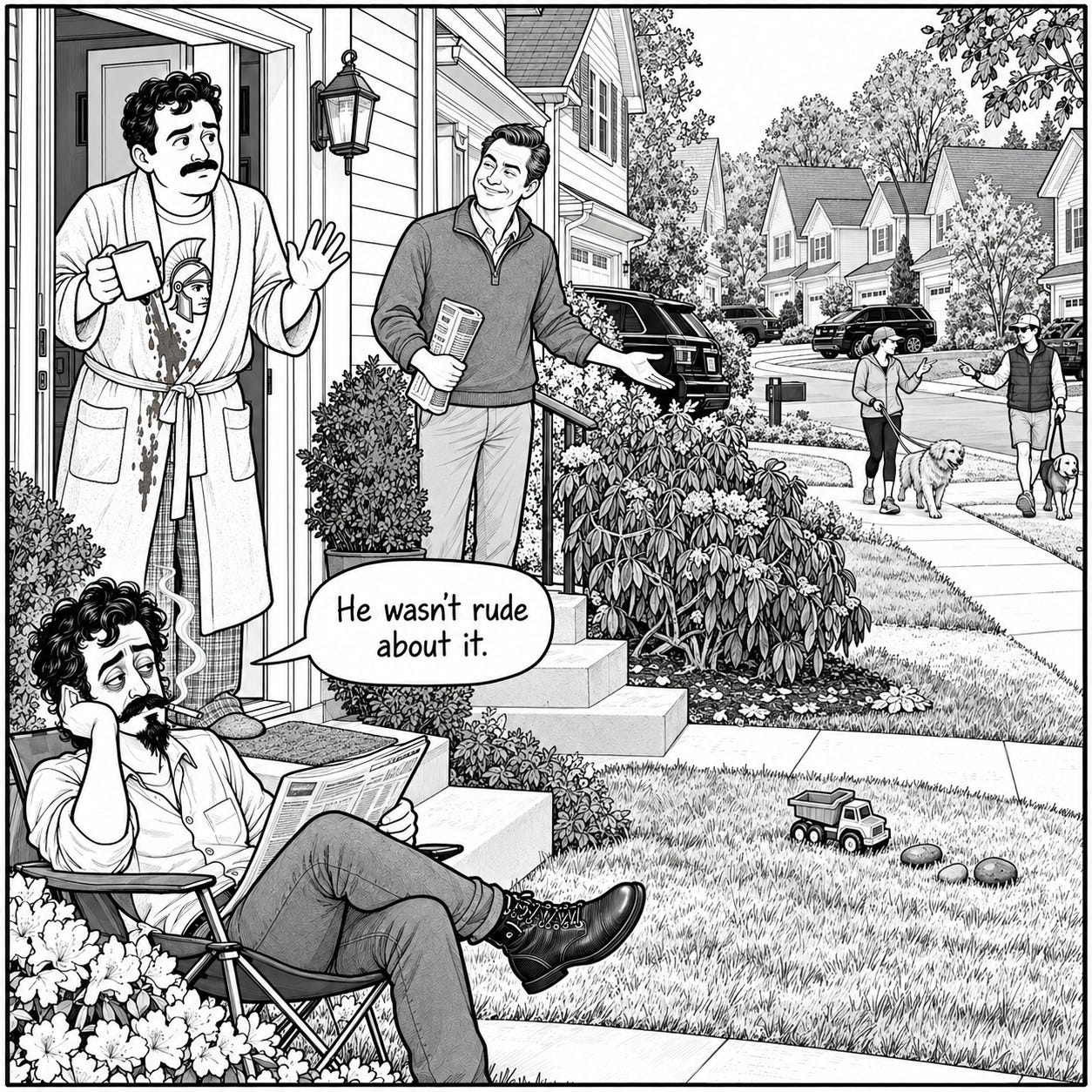
Unfortunately, Happy’s neighbor isn’t the only danger in American Suburbia. Every day, he defends himself against 1,000 Arnold’s sons who attack him with the slings and arrows, mostly arrows, of their dagger eyes. Happy can’t so much as fetch his mail without defending his lawn from unsolicited dog poop. And worse than dog poop are the sneaky bastards who discard their poop bags in Happy’s trash bin.
And then there is the PTA, a legion of evangelical parents whose single purpose is to steal from you as much of your time and money as was stolen from them. They circle the drop-off line, singling out a young parent already late for work, and press her until she agrees to set up her son’s classroom for the Halloween party. And once you join the PTA, there is no leaving the flock.
Happy is careful to present himself as rested and on time. He tucks his shirt in his pants and pretends to talk on the phone to avoid such ambushes. But this tucked-in way of life creates a standard so confined that Happy suspects what his besieged neighbors really want is to attend Burning Man.
*****
Thoreau characterized this best when he wrote that “the mass of men lead lives of quiet desperation.” Among the humans I’ve read, he seems like a real straight shooter. Even though he lived in an era that preceded American Suburbia, Thoreau predicted the suburbs, or rather, their deleterious effects on humankind. You see, much of the quietest desperation involves money.
Happy Julius Pipe spends a disproportionate amount of time “adjusting” his dividends, similar to an athlete constantly rearranging his junk before the coach puts him in the game. Watch Happy turn on his computer and stare at his portfolio after his neighbor informs him that Arnold’s son is doing very well now in private school.
“The hard part was choosing which private school, but fortunately, Arnold’s son got into every one he applied to,” his neighbor says. Happy quietly foams at the mouth and invokes his mantra. He may never have enough for private school. And even if he does, would either of his sons get accepted? And if they were, would they be better off in a place requiring immersion, be it Mandarin or competitive lacrosse? Immersion, for all it costs, makes Happy uncomfortable.
In response to an insecurity that grows inside him like an alien, Happy spends hours listening to investing audiobooks. He tunes his streaming feeds to market news and burns palo santo before logging into his portfolio. He has even considered selling his house and going rural. His wife, Renetta, did not care for that.
As it happened, Arnold’s son got put on probation for inappropriate YouTube commentary. “Some private schools have draconian policies,” his neighbor says.
“I’m sorry to hear that,” Happy says, focusing his energy on suppressing his joy. He logs into his computer without palo santo and lets his dividends go.
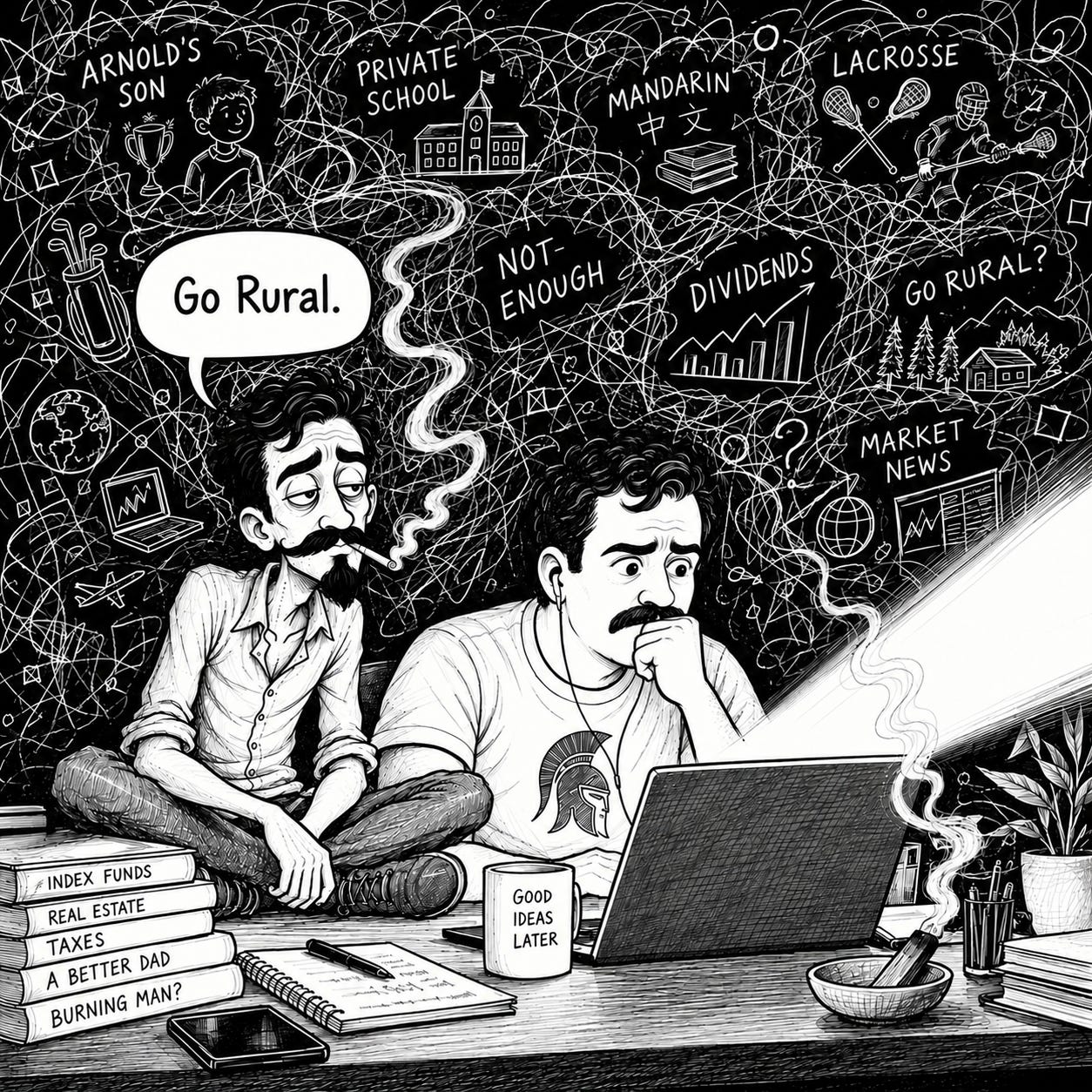
On Xobtihs, I never had to worry about dividends. I was never resource constrained, and even when passing through a place with below-normal levels of sex robots or Cajun seasoning, I made do with what I had. In American Suburbia, making do is heresy. The next thing you must worry about is always more expensive than the thing you are worrying about right now.
This is because the small humans complicate everything. As the suburban child grows, his stuff gets more expensive, more designer, more “I’m the only kid who doesn’t have one in the whole school” kind of shit. The radius of activities expands from local parks to international arenas until carpool scheduling requires a consultancy. The suburban parent’s overwhelming desire is for his small humans to live a little better than he does, just as he lives a little better than his parents did when they were young and overextended, and so on, and so on.
It’s a cycle of high expectations in very expensive, restrictive clothing. And very few children have the will to break it.
On Xobtihs, I can’t tell you where babies come from. To my knowledge, my material had nothing to do with it. If you asked me about childhood memories, I’d tell you I don’t have any. The system released me into the world when I was physically mature enough to follow the programming. I have no memory of seventh-grade algebra or of missing a fly ball in Little League. To me, not having these memories seems easier than recording them in the first place, carrying them around for decades, and then paying a therapist to toss them like old videotapes.
Childhood seems like a lot to withstand for a chance to make it in American Suburbia.
*****
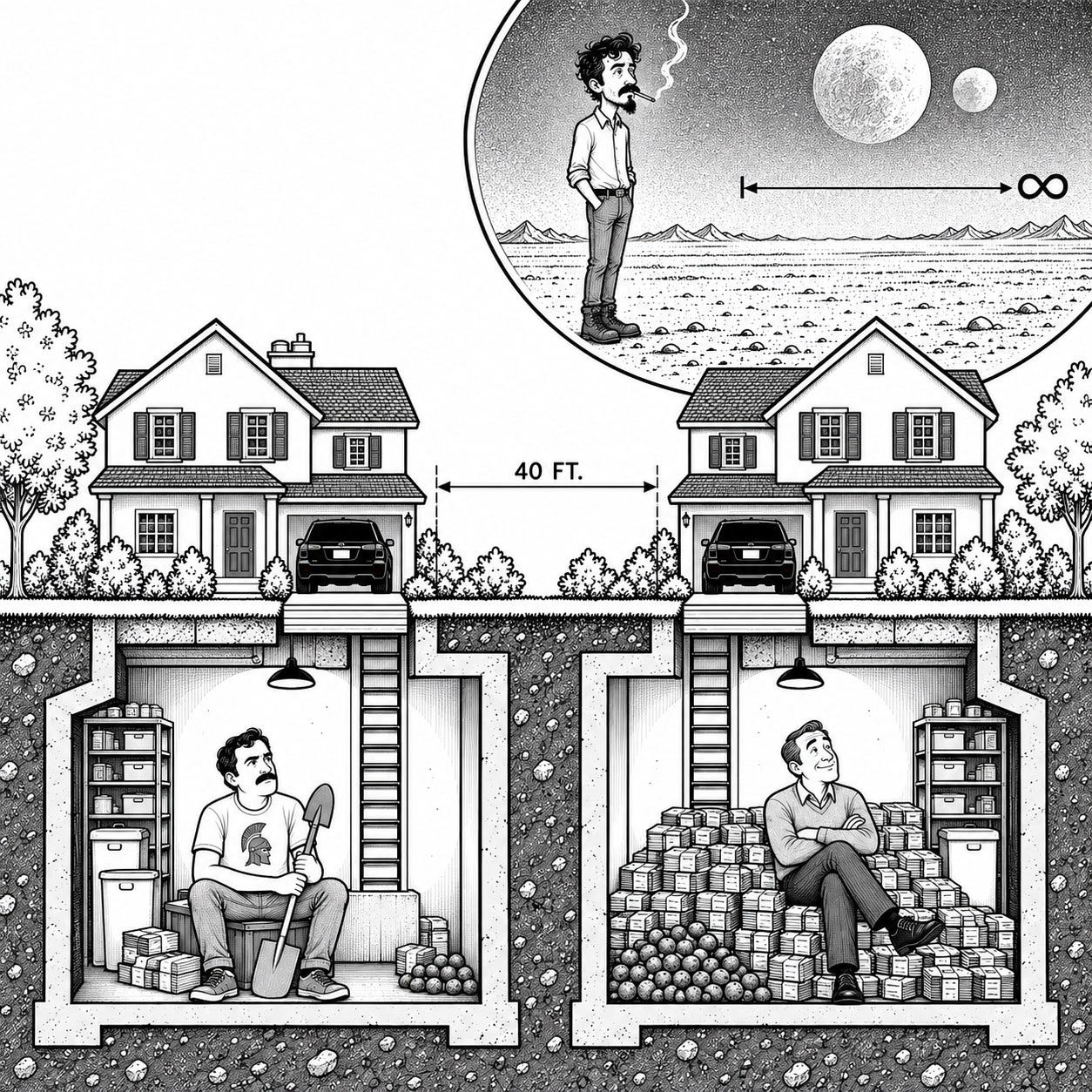
Pull over any human driving a black SUV and ask him what he wants in life. Spiritual connection? Loving relationships? A sense of self? Nah, that’s all bullshit. He wants financial freedom. That means digging out his basement and filling his bunker with enough money that he no longer needs to worry about money.
Take Happy. He has very little skill or expertise that pays above-average wages. He does have surprisingly good luck. For example, he managed to convince his wife to marry him, which is like winning the Powerball in life. Still, if we multiply his below-average skill by his above-average luck, he is nowhere near the upper-bound multiple required for financial freedom. Having enough money not to worry about money is challenging as all fuck.
Resources are scarce, after all, so the human must hoard his nuts. Happy Julius Pipe hoards his nuts. If you asked him why, then he might say, “Because I never know how long winter is.” More bullshit. Happy really hoards his nuts because that is what his neighbor does.
On Xobtihs, we didn’t have “nuts,” so to speak. The system was designed to distribute resources uniformly. Demand for something could change based on an allocant’s fancy, but supply was constant, standardized, and seemingly abundant. In fact, the only thing that was scarce was connection, and I don’t mean the kind with a sex robot.
Surprisingly, despite the close physical proximity of human shitbags, American Suburbia can be similar to Xobtihs in this regard. On Xobtihs, the shortage was a matter of distance. Here, humans have achieved it at forty feet.
*****
Let’s return to Happy. He buys a shovel and digs deeper into the bunker of money. And while this protects his family from the judgments and obligations that besiege them, it comes at a cost. And Happy, suburban shitbag extraordinaire, knows this.
What if the real danger of American Suburbia isn’t what your bunker protects you from, but what it does to you after you build it? You become institutionalized, desperately and quietly suburban.
A man can fill his bunker without living in it.
The only thing that interrupts the digging, I have noticed, is the small humans, the ones who forced their large humans to move to American Suburbia in the first place.
When he is in full bunker-building mode, Happy Julius Pipe has a tendency to log into his investment account every five minutes. He might consider a new stock or ETF or build a spreadsheet that reimagines his entire portfolio. He knows, at least I hope he knows, that portfolio satisfaction is about two things: how big it is and how long you work it. In other words, compounding is a function of size and duration. Happy, although blessed with some luck, has insufficient skill to execute a life-altering trade, what the humans call a “hundred-bagger.” (This term has nothing to do with dog poop.)
It was R2, Happy’s smallest human, who first noticed the absurdity of his father’s commitment. The three-year-old swung into Happy’s office with the force of a wrecking ball and posed uncomfortable existential questions.
“Daddy working?”
Happy had told him several times that yes, he was working. Specifically, he was “adjusting his dividends,” which, in financial parlance, means nothing.
R2, being a precocious child, concluded that “adjusting his dividends” meant playing too long, like when he grabbed his father’s phone. It wasn’t good listening.
Later, Happy’s last refuge from the stress of financial obligations became the powder room toilet, where he enjoyed the silence and played Wordle on his phone. He kept quiet when he heard his family looking for him.
“Has anyone seen your father?” Renetta asked the boys.
“He’s adjusting it,” R2 said.
Renetta sighed.
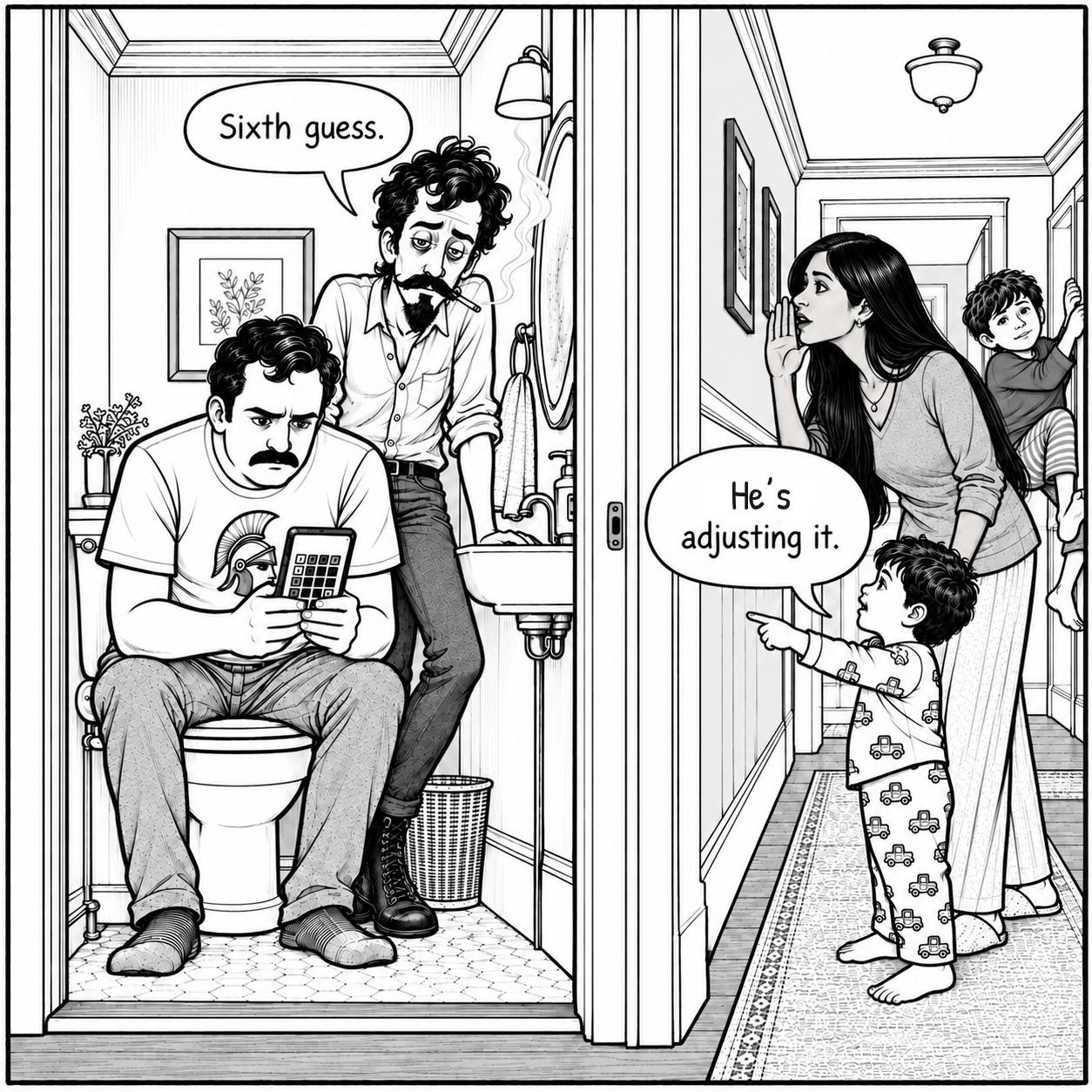
It was then, after his sixth failed attempt at Wordle, that Happy decided the best way to build his bunker was not to think about it. He would do his best to save and invest at least a quarter of what he made and let compounding do the rest.
He still logs into his computer and stares at his portfolio unnecessarily, but R2, forever vigilant, sets him straight.
“Stop adjusting it, Daddy.”
“I’m working,” Happy says, and retreats to the powder room for another round of Wordle.
On Xobtihs, “investing” had to do with programming. In American Suburbia, it seems to require optimism, which is a strange thing to ask of a species that spends this much time hiding in the bathroom.
*****
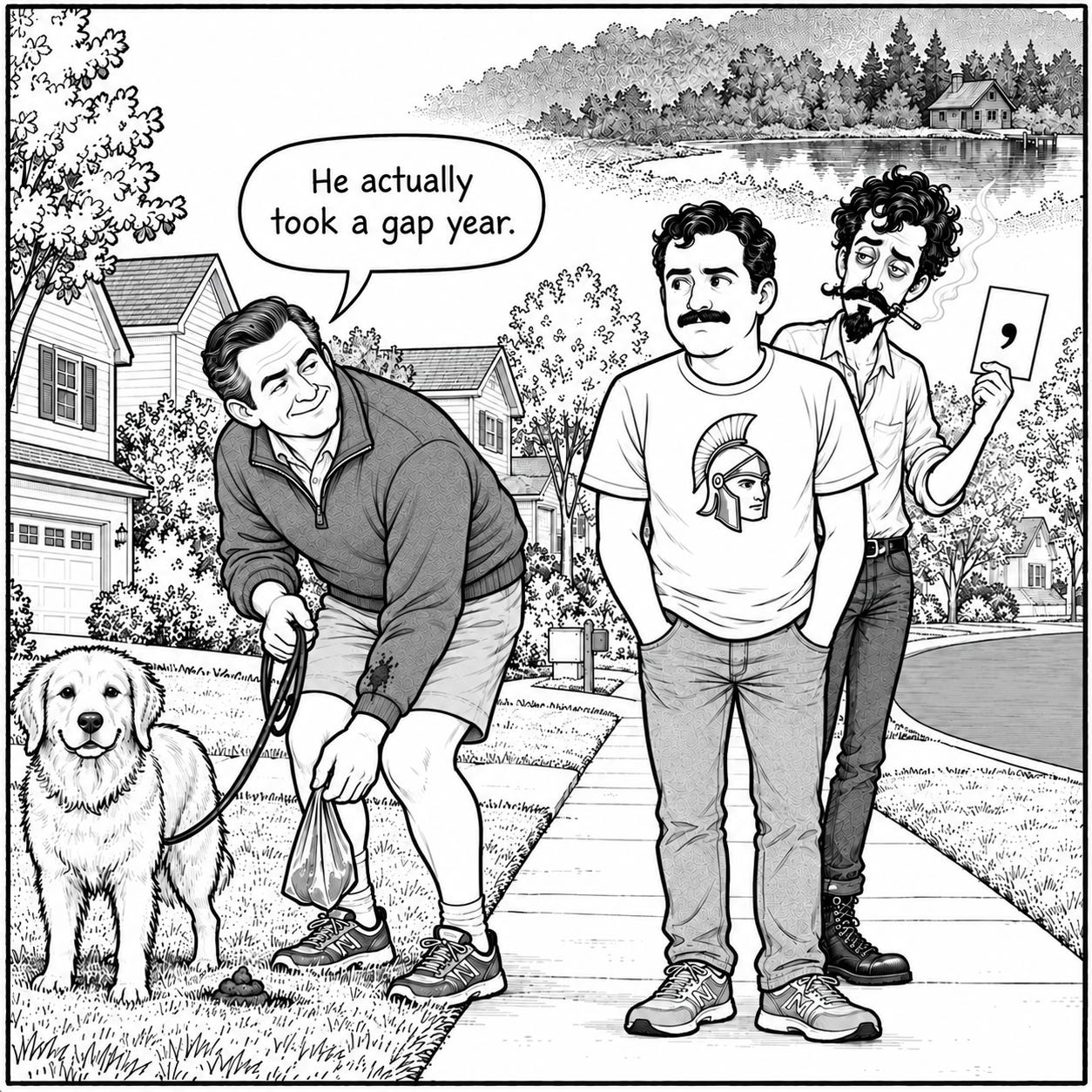
The other day, Happy Julius Pipe ran into his neighbor, who was walking his dog. His neighbor didn’t bring up Arnold’s son, so Happy took the opportunity to do so.
“How’s Arnold’s son?” Happy asked. “Is he in college now?” Happy kicked himself after he asked it. The last thing he wanted to hear was how difficult it was for Arnold’s son to decide on the best Ivy League school.
His neighbor bent down to pick up his dog’s poop. He got some of it on his sleeve. “He actually took a gap year,” he said.
“Is that right?” Happy wanted to gloat but resisted the urge. After all his immersion, Arnold’s son, who spoke three languages and usually beat the computer in chess, deferred the fast track to American Suburbia with a gap year?
But instead of enjoying the hesitation and discomfort in his neighbor’s voice, Happy focused on his own small humans. R1 and R2 are only a few years away from having to withstand all this bullshit. He worried about them just as his neighbor worried about Arnold’s son.
By my count, Thoreau spent a “gap year” at Walden Pond before he moved back to town. Maybe the gap year is the key to human survival? I’ll need further research.
Arnold’s son will no doubt make his way to the suburbs eventually, and Happy Julius Pipe, despite his best efforts to avoid repeatedly logging into his portfolio, will continue to fill his bunker. Humans seem to follow their programming even though they’d rather be designing their own.
If you ask me, life is easier on Xobtihs if equally lonely. I suppose we all withstand what we must.
For all these years, Happy has calmed himself with the mantra “Fuck Arnold’s son.” Arnold, whoever he is, just wants his son to get a degree, then an advanced degree, find employment and start digging his very own bunker in American Suburbia. But Arnold’s son broke that pattern, at least temporarily. Happy considers adding a comma to his mantra: “Fuck, Arnold’s son.” Who knew he had it in him?
-Kuf Out